
Artificial Intelligence — or AI — isn’t just a buzzword anymore. It’s a rapidly advancing technology that’s becoming part of everyday life, across countries, industries, and communities. But what actually is AI? And how is it being used today around the world? In this article, we explain AI in simple, accessible language, explore how it works, and highlight real-world examples of its global implementations
What Is AI — In Simple Terms
AI refers to computer systems or software built to simulate human-like intelligence. That means these systems can learn, reason, understand, and make decisions — much like we humans do.
Instead of relying on a fixed set of rules, many modern AI systems learn from data and experience. Over time, they improve — adapting to new patterns, updating predictions, refining decisions. This learning-from-data approach gives AI its flexibility and power.
How AI Works — The Core Ideas
You don’t need to be a computer scientist to get the basic idea of how AI works. Here’s a high-level overview:
• Learning from Data
Many AI systems use techniques like machine learning or deep learning. They analyze large datasets — images, text, numbers, user behavior — to find patterns. Once trained, they can make predictions or perform tasks automatically.
• Perception: Seeing, Hearing, Understanding
AI can “perceive” the world through inputs like images, voice, or text. With technologies like computer vision and natural-language processing, AI can interpret images, recognize faces, understand language, translate, or even summarize text.
• Reasoning & Decision-Making
AI systems can analyze information, weigh options, and make decisions — often much faster than humans, and without fatigue or bias (provided the data is good).
• Automation & Adaptation
Because AI learns from data, it can adapt when things change. Once trained, it can perform repetitive or complex tasks automatically — enabling greater efficiency, consistency, and scale.
Where AI Is Already at Work — Global Applications
AI is no longer confined to labs or theory — with so many AI tools available for almost every major sector it’s already shaping many aspects of modern life worldwide. Here are key areas where AI is making a real difference
Healthcare & Medicine
- AI-driven tools assist in medical diagnostics (like analyzing radiology images), enabling early detection of diseases and more accurate diagnoses.
- In many places, AI supports drug discovery and research, helping scientists accelerate the development of new medicines.
- AI-powered systems also help manage patient data, predict health risks, and support personalized treatment plans — bringing efficiency and precision to global healthcare.
Business, Finance & Enterprise
- Worldwide, many companies now use AI for tasks like fraud detection, risk assessment, financial forecasting, and customer analysis — improving decision-making, speed, and reliability.
- In 2025, a majority of firms globally report using AI in at least one business function — a major shift from just a few years ago.
- Businesses also deploy AI for marketing, customer support (via chatbots), forecasting demand, automating routine tasks — making operations more efficient and scalable.
Everyday Tech, Smart Devices & Services
- AI powers many of the technologies we use daily: smartphones, virtual assistants, smart-home devices, navigation apps, voice recognition, content recommendations — enriching convenience and personalization globally.
- From tailored entertainment (music, streaming suggestions) to intelligent search engines, online shopping recommendations and personalized content — AI quietly works behind the scenes to shape user experiences.
Education & Learning
- Across the world, AI is enhancing education: adaptive learning platforms tailor lessons to each student’s pace and style, making learning more effective and inclusive.
- Administrative tasks like grading, scheduling, and feedback systems are also being automated — giving teachers more time for teaching and students more timely support.
Industry, Manufacturing & Infrastructure
- In manufacturing and industrial settings, AI helps with predictive maintenance, quality control, supply-chain optimization, and automation — boosting productivity and reducing waste.
- As companies worldwide integrate AI deeper into workflows, industries become more data-driven, smarter, and more resilient.
Why AI Matters — Global Significance & Benefits
AI isn’t just a tech trend — it’s becoming a foundational technology with broad global impact. Here’s why it matters.
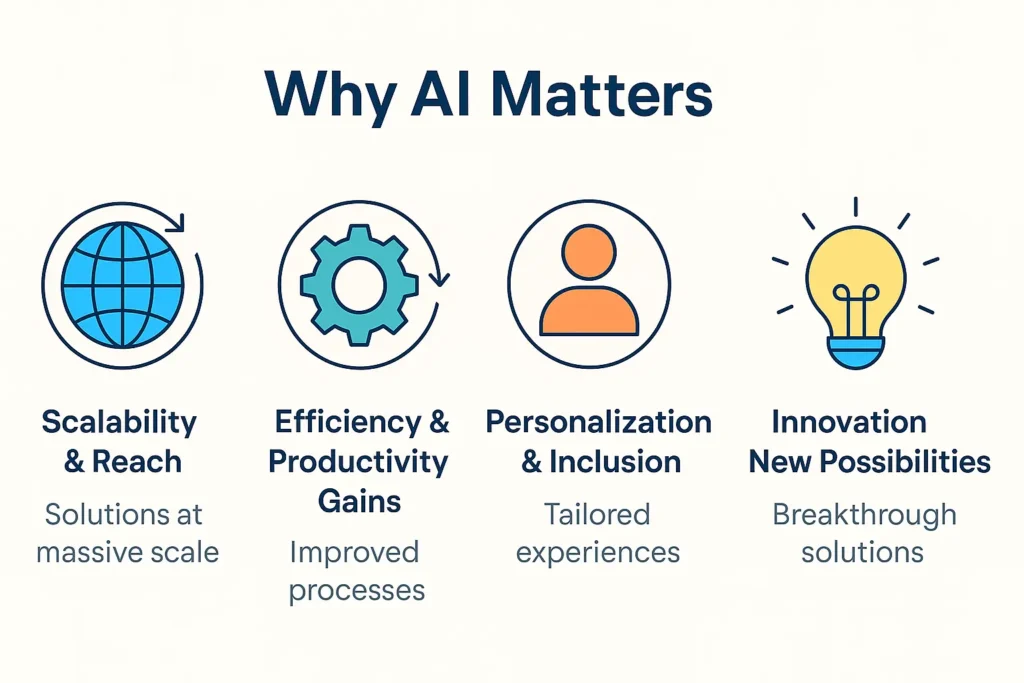
Scalability & Reach
AI enables solutions that can work at massive scale — whether it’s analyzing millions of medical images, running global supply chains, or delivering personalized experiences to users across continents.
Efficiency & Productivity Gains
Organizations adopting AI report significant improvements: faster processing, reduced errors, better decision-making, and lower costs. In some industries, productivity gains are already measurable.
Personalization & Inclusion
Through AI, services like education, healthcare, entertainment, and commerce can be tailored to individual needs — making them more accessible regardless of geography or background.
Innovation & New Possibilities
AI is enabling innovations that were once science fiction — from precision medicine to smart infrastructure, from intelligent manufacturing to adaptive learning platforms. The frontier keeps expanding.
Challenges & Considerations — What We Must Watch
As AI advances, certain risks and challenges come into focus. Being aware of them is key to making AI beneficial for everyone.
• Uneven Global Adoption
Not every country or region has equal access to computing infrastructure, internet connectivity, or trained personnel — which means AI’s benefits may not reach all equally. (Digital divide remains a concern.)
• Job Displacement & Skills Shift
As AI automates routine and repetitive tasks — especially in industries and administrative work — some jobs may be lost or transformed. However, new roles (especially skilled ones) will likely emerge.
• Data Quality, Privacy & Ethical Risks
AI’s effectiveness depends on quality data. Biased or flawed data can lead to biased results. There are also growing concerns about privacy, data security, transparency, and fairness in AI decision-making.
• Overpromise vs. Real Expectations
While AI has huge potential, not all promises may be realized. For some companies, AI brings modest gains — not transformation. Success often depends on how well AI is integrated with human strategy, data governance, and long-term vision.
The Future of AI — What’s Next for the World
Looking ahead, AI’s role will likely expand — but success will depend on how responsibly we shape its development and adoption. Some expected trends:
- Broader global adoption: As infrastructure improves, more countries and sectors — especially in developing regions — may join the AI revolution.
- More human-AI collaboration: Rather than replacing humans entirely, many roles may evolve — combining human creativity, judgement, empathy with AI’s speed and precision.
- New services & industries: From generative-AI content creation to smart humanities, personalized medicine, and adaptive education — many new forms of services and jobs will arise.
- Emphasis on ethics, fairness & regulation: As AI becomes more widespread, ensuring responsible use, protecting privacy, and preventing bias will be essential for public trust.
- Greater innovation, research, and global cooperation: The pace of AI development is accelerating — and so opportunities for collaboration, shared data, and cross-border problem solving.
Conclusion
Artificial Intelligence is no longer a futuristic dream. It’s real — and it’s already reshaping how we live, work, learn, heal, and connect. From hospitals and factories to education and smart devices, AI’s footprint is global and growing.
But with great power comes great responsibility. The way we adopt, regulate, and steer AI will determine whether it becomes a force for inclusion, innovation, and trust — or one that deepens divides and risks.
For a global audience — from students to business leaders to everyday tech users — understanding AI isn’t optional. It’s essential. Because as AI becomes more central to our lives, informed awareness and thoughtful adoption will shape a better, smarter, fairer future for all.
Pingback: AI + IoT Explained: Meaning, Architecture, Use Cases & Benefits - gadget180.com
Pingback: How AI and ML Are Changing the IT Industry - gadget180.com
Pingback: Agentic AI: The New Era of Autonomous Intelligence Explained - gadget180.com
Pingback: The Best AI Tools for Students, Creators, Developers, and Businesses - gadget180.com