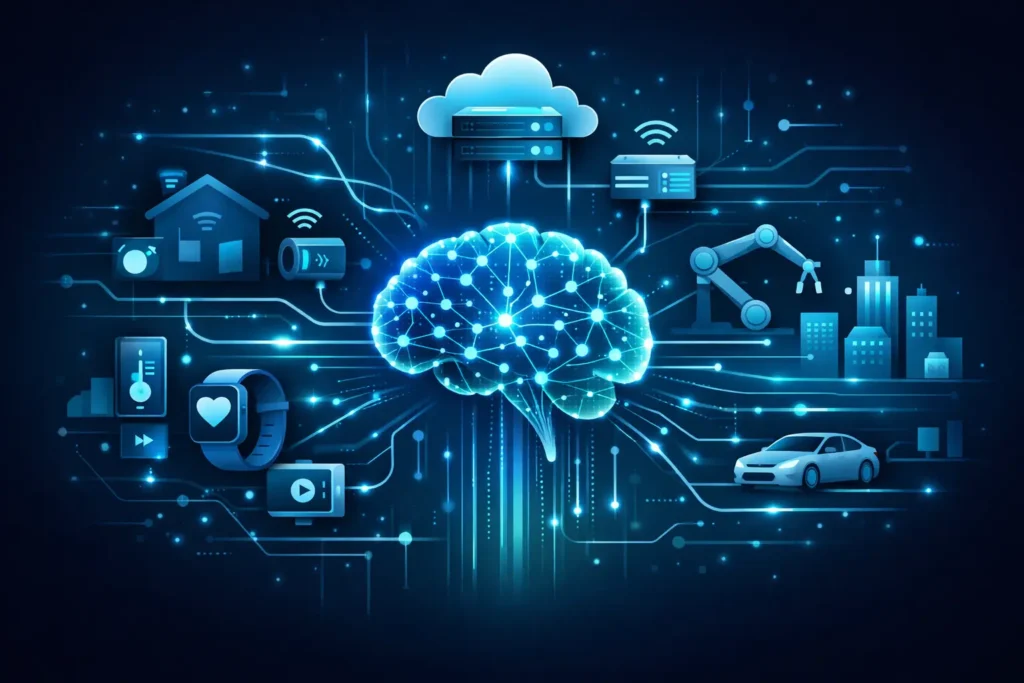
The world is increasingly filled with connected devices. From smartwatches and home assistants to industrial sensors and city infrastructure, billions of devices are constantly collecting data. However, data on its own has limited value unless it can be analyzed, understood, and acted upon intelligently. This is where the convergence of Artificial Intelligence (AI) and the Internet of Things (IoT) becomes transformative.
Together, AI and IoT create intelligent systems that can sense real-world conditions, learn from data, make decisions, and take action automatically. This convergence is often referred to as AIoT (Artificial Intelligence of Things) and is rapidly becoming a foundational pillar of modern digital systems.
What Is AI and IoT (AIoT)?
AI and IoT refers to the integration of artificial intelligence technologies with IoT devices and systems.
- IoT enables physical devices to collect and transmit data from the real world using sensors and connectivity.
- AI enables machines to analyze data, recognize patterns, make predictions, and improve decisions over time.
When combined, IoT provides the data and AI provides the intelligence. The result is a system that goes beyond basic automation and becomes predictive, adaptive, and autonomous.
Why AI and IoT Matter Today
Several technological shifts have accelerated the adoption of AIoT:
- Massive Growth of Connected Devices
Sensors are now embedded in homes, vehicles, factories, farms, and cities. - Advances in Artificial Intelligence
Modern machine learning models can analyze complex data streams in real time. - Edge Computing and Faster Networks
Decisions can be made closer to devices, reducing latency and improving reliability.
Together, these developments allow systems to move from simply reporting data to actively interpreting and responding to real-world situations.
AIoT System Architecture Explained
An AIoT system is typically organized into layered components that work together seamlessly.
1. Device Layer (Sensors and Actuators)
This layer includes physical devices such as:
- Temperature and humidity sensors
- Motion and proximity sensors
- Wearables and health monitors
- Industrial machines and robots
These devices capture real-world signals and, in some cases, perform physical actions.
2. Connectivity Layer
This layer transports data from devices using technologies such as:
- Wi-Fi
- Cellular networks (4G/5G)
- Low-power wide-area networks (LPWAN)
Reliable connectivity ensures continuous data flow.
3. Edge and Cloud Computing Layer
- Edge computing processes data locally for fast responses.
- Cloud computing handles large-scale analytics, storage, and model training.
Most modern systems use a hybrid approach.
4. AI and Analytics Layer
Machine learning models analyze incoming data, detect patterns, predict outcomes, and generate decisions.
5. Action Layer
Decisions are translated into actions such as:
- Adjusting device settings
- Triggering alerts
- Activating machines or systems automatically
This closed loop enables continuous improvement.
Edge AI vs Cloud AI
AI in IoT systems can operate at different locations. The choice depends on performance and privacy requirements.
| Factor | Edge AI | Cloud AI |
|---|---|---|
| Response Time | Very fast (real-time) | Slower (network dependent) |
| Data Privacy | High (local processing) | Lower (data transmitted) |
| Bandwidth Usage | Low | High |
| Compute Power | Limited | Very high |
| Best Use Cases | Safety, automation, instant control | Model training, large-scale analytics |
Edge AI is ideal for time-critical and privacy-sensitive tasks, while cloud AI excels at deep analysis and long-term learning.
Traditional IoT vs AI-Powered IoT
| Traditional IoT | AI + IoT (AIoT) |
|---|---|
| Data collection only | Data understanding and learning |
| Rule-based automation | Intelligence-driven decisions |
| Reactive responses | Predictive and proactive behavior |
| Manual analysis | Autonomous operation |
| Limited optimization | Continuous improvement |
AIoT systems are capable of anticipating problems and optimizing performance automatically.
Real-World Applications of AI and IoT
Smart Homes
AI learns user behavior while IoT devices manage lighting, climate, and energy usage. Homes become more comfortable, efficient, and personalized over time.
Healthcare
Wearable devices continuously monitor vital signs. AI analyzes trends to detect anomalies early, enabling preventive care and timely intervention.
Manufacturing
Sensors monitor machine health while AI predicts equipment failures before they happen. This reduces downtime, improves safety, and lowers maintenance costs.
Smart Cities
AIoT systems manage traffic flow, optimize energy consumption, improve waste management, and enhance public safety in real time.
Agriculture
Soil sensors, weather data, and AI models automate irrigation, optimize fertilizer use, and increase crop yield while conserving resources.
Market Growth and Business Value
AI and IoT adoption continues to grow across industries due to:
- Reduced operational costs
- Improved efficiency and productivity
- Enhanced safety and reliability
- Better customer and user experiences
As systems become smarter and more autonomous, AIoT is shifting from a competitive advantage to a standard requirement.
Key Challenges of AI and IoT
Despite its benefits, AIoT comes with challenges that must be addressed.
Security and Privacy
Connected devices increase the attack surface. Weak authentication, unpatched firmware, and insecure communication can expose systems to risk.
Mitigation strategies include:
- Secure device identity and authentication
- Encrypted data transmission
- Network segmentation
- Continuous monitoring and updates
Data Quality
Poor sensor data leads to inaccurate AI decisions.
Solutions include:
- Data validation at the edge
- Consistent data standards
- Regular calibration and monitoring
Cost and Complexity
Deploying AIoT systems involves hardware, software, and skilled talent.
Best practice: Start with focused pilot projects and scale after measurable results.
How to Implement an AIoT System Successfully
A structured approach improves success rates:
- Define a clear business objective
- Start with a small, focused pilot
- Design reliable data pipelines
- Decide what runs at the edge vs the cloud
- Train and optimize AI models
- Monitor performance and model accuracy
- Continuously improve and scale
Strong governance and lifecycle management are essential for long-term success.
Frequently Asked Questions
What does AI and IoT mean?
AI and IoT refers to the integration of artificial intelligence with connected devices to create intelligent, automated systems that can sense, analyze, and act.
What is the main advantage of AIoT?
AIoT enables predictive decision-making, automation, and continuous optimization rather than simple data collection.
Is AIoT suitable for small businesses?
Yes. Many solutions start with small pilots and scale gradually, making AIoT accessible beyond large enterprises.
Is AIoT secure?
It can be secure if best practices such as encryption, authentication, and monitoring are followed.
Conclusion
IoT connects the physical world. AI gives that connection intelligence.
Together, AI and IoT enable systems that can sense their environment, think intelligently, learn continuously, and act autonomously. From homes and hospitals to factories and cities, AIoT is redefining how technology interacts with the real world.
As adoption grows and technology matures, AI and IoT will become a foundational layer of future digital infrastructure, shaping a smarter, safer, and more efficient world.