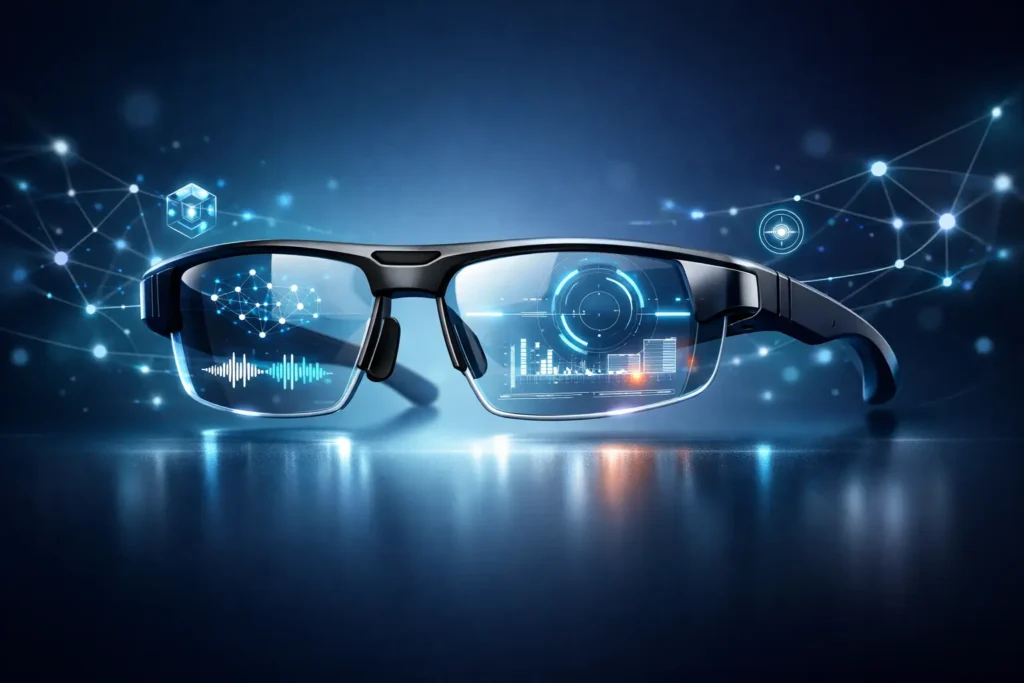
In last couple decades we’ve seen an exponential rise in the tech world, from smartphones to smartwatches, IoT devices and other smart wearable techs. In this fast evolving tech world people are spending more and more time in-front of screens whether its scrolling social media or for work. The Smart Glasses paired with AI(Artificial Intelligence) gives a new perspective on how we use and operate digital devices, it has the potential to make people move away from screens(smartphones, laptops etc.) giving a completely new way to how we use smart devices.
AI-powered smart glasses are a new trend in the wearable tech section, now when you want to take a photo or record a video, you won’t need to take out your smartphone from your pockets instead with these smart AI glasses you can do that instantly while enjoying the moment, these AI glasses can hear and understand your voice and respond intelligently. They are designed to blend into daily life, offering assistance without demanding attention.
What are AI glasses?
AI glasses are wearable smart devices in the form of eyewear that integrate artificial intelligence to provide real-time assistance through voice, audio, sensors, cameras, and sometimes visual displays.
AI glasses typically fall into three broad categories:
1. Audio-First AI Glasses
These glasses do not include a visual display. They rely on microphones, speakers, and AI assistants to provide voice-based help such as answering questions, playing audio, translating speech, or capturing moments.
2. Camera-Enabled AI Glasses
These glasses use onboard cameras to understand the world visually. AI can analyze what the wearer sees and provide contextual information, explanations, or assistance.
3. Display or AR-Based AI Glasses
These glasses include a small display or augmented reality layer that overlays information such as directions, captions, or notifications directly into the user’s field of view.
Not all AI glasses include every feature. Many current products focus on one or two strengths to balance usability, privacy, and battery life.
What can AI glasses do today?
AI glasses are no longer experimental concept. Several practical use cases are already emerging. Here are a list of few areas where AI glasses can be practical and useful:
Everyday AI Assistance
AI glasses can act as personal AI assistant that is always available. Task like taking notes, clicking pictures, getting summaries etc, can be done without the use of hands. This can be useful when you need these tasks done while doing some work, walking, cooking etc.
Hands-Free Communication
Calls, messages, and notifications can be handled through voice commands and open-ear audio. Some models support real-time language translation or live captions, making communication more accessible.
Audio and Media Experiences
Open-ear speakers allow users to listen to music, podcasts, or navigation cues while remaining aware of their surroundings. This is a key advantage over headphones in public spaces.
Content Capture and Creation
Camera-enabled AI glasses allow quick photo and video capture from a first-person perspective. This capability has made them popular among creators who want spontaneous, immersive content.
Accessibility Support
I glasses show strong potential for accessibility, helping users with visual or hearing challenges through object recognition, scene descriptions, speech-to-text captions, and navigation assistance.
The Technology Inside AI Glasses
Behind their simple appearance there is a stack of technology working together to make this technology possible and easy to use.
Sensors: How AI Glasses Perceive the World
- Microphone arrays capture voice clearly while reducing background noise
- Cameras provide visual input for AI understanding
- IMU sensors track head movement and orientation
- Environmental sensors help with spatial awareness in advanced models
These inputs allow AI systems to understand context, not just commands.
Audio Systems: Open-Ear Design
Most AI glasses use directional, open-ear speakers instead of earbuds. This design allows users to hear AI responses without blocking external sounds, improving comfort and safety.
Where the AI Runs: On-Device, Phone, or Cloud
AI processing usually happens in one of three ways:
- On-device AI offers fast responses and better privacy but is limited by power and heat
- Phone-tethered AI uses a connected smartphone for heavier tasks
- Cloud AI delivers the most advanced intelligence but depends on internet connectivity
Many current AI glasses use a hybrid approach to balance performance and efficiency.
Connectivity and Ecosystem
Bluetooth and Wi-Fi enable communication with smartphones and cloud services. Companion apps are essential for updates, customization, and integration with other digital tools.
Displays and Visual Overlays
When present, displays are typically minimal and designed for quick glances. Instead of replacing reality, they enhance it with subtle information such as navigation cues or captions.
New Input Methods
Beyond voice, AI glasses are exploring touch controls, gestures, head movements, and even neural or muscle-based inputs through companion wearables.
Companies Building AI Glasses
Many startups and big companies have invested in building smart wearable tech including AI glasses, some of the major players in the sector are:
Meta and Ray-Ban
Meta is one of the key players in the sector, Meta has partnered with eyewear giants like Ray-Ban(Luxottica) and Oakley, leveraging their designs and combining the tech from meta, it has created Smart AI glasses that is not just smart but also cool. Some of their models are:
Google is positioning AI glasses as part of its broader AI and extended reality ecosystem, focusing on context-aware assistants and platform-level innovation, Google will launch their first AI-powered smart glasses in 2026.
Snap
Snap has long experimented with smart eyewear, using AR and spatial computing as a foundation for future consumer AI glasses.
XREAL
XREAL focuses on lightweight AR glasses that emphasize displays and spatial experiences, often used with external compute devices.
Brilliant Labs
Brilliant Labs takes an open and experimental approach, targeting developers and early adopters interested in customisable AI glasses.
Challenges AI glasses face
Despite of so many developments in the sector their are many challenges to overcome:
- Privacy and Social acceptance: Cameras and microphones raise the concern of privacy and consent. Makers must make sure that these devices are secure and trusted.
- Battery Life and Heat: Packing of so many sensors, speakers and AI can lead to heating and energy issues.
- Accuracy and Reliability: AI has become much advanced but still it isn’t completely accurate and can sometimes produce irrelevant or inaccurate results.
The future of AI glasses
AI glasses are still early, there are many companies experimenting and developing new technologies around it, but as the tech evolves we can see that it can be a useful tool which can bring huge change in the wearable tech industry and the way we communicate with devices, it won’t be surprising if you are making a call or summarising notes not with a smartphone or laptop but with your glasses. With all this being said, it is not necessary that AI glasses will replace other devices like smartphones, instead they can act as an added layer in your tech stack that you use daily and can make you more productive making your work easier.
As artificial intelligence becomes more capable, AI glasses will also evolve and bring ease in working.