The year 2026 marks a clear shift in technology. Gadgets are no longer defined only by hardware specs or sleek designs. The most influential tech of this year blends artificial intelligence, software intelligence, and real-world action into systems that actively assist, decide, and operate.
Instead of asking what device is new, the better question in 2026 is what system changes how we work, compute, and live.
Based on industry momentum, platform adoption, and real-world impact, here are the top three tech gadgets of 2026 that stand out across AI, software, and intelligent automation.
1. AI PCs with Dedicated NPUs: The New Standard for Personal Computing
For years, AI features on laptops depended heavily on cloud servers. In 2026, that dependency breaks. The rise of AI PCs with powerful on-device NPUs (Neural Processing Units) is one of the most important technology shifts of the decade.
Leading this transition are next-generation processors from companies like Qualcomm, especially the Snapdragon X-series chips designed specifically for AI-first computing.
What makes AI PCs different in 2026?
Traditional laptops rely on CPUs and GPUs for everything. AI PCs add a third brain: the NPU, optimized for machine learning tasks such as language processing, image recognition, and real-time inference.
These NPUs can handle tens of trillions of operations per second, allowing AI workloads to run locally, faster, and more efficiently.
Real-world benefits users actually notice
This shift is not theoretical. It changes daily computing in tangible ways:
- Offline AI features like live captions, translations, and summarization
- Instant response times without waiting for cloud servers
- Better privacy, since sensitive data stays on the device
- Improved battery life, as NPUs consume far less power than GPUs
Tasks like cleaning up meeting audio, generating document summaries, or enhancing webcam video now happen silently in the background.
Why this matters in 2026
Software developers are finally building applications that expect an NPU to exist, much like GPUs became standard years ago. This makes AI a built-in capability rather than an optional add-on.
In 2026, buying a laptop without a capable NPU feels like buying one without Wi-Fi. AI PCs are no longer niche. They are the default future of personal computing.
2. Microsoft 365 Copilot with Agent Mode: Software That Actually Works for You
If AI PCs redefine hardware, AI agents redefine software.
In 2026, Microsoft’s evolution of Copilot inside Microsoft 365 stands out as one of the most impactful software “gadgets” of the year.
Copilot is no longer just a writing assistant. With Agent Mode, it becomes an active participant in your work.
From chatbot to digital coworker
Earlier AI tools responded to prompts. Copilot in 2026 understands context, remembers ongoing tasks, and operates across applications like Word, Excel, Outlook, and Teams.
It can:
- Read meeting notes and generate structured action plans
- Analyze spreadsheets and explain insights in plain language
- Draft documents based on emails, files, and past work
- Summarize long conversations and extract decisions
This turns AI from a helper into a workflow engine.
Agent Mode: the real breakthrough
Agent Mode allows Copilot to perform multi-step tasks instead of single responses.
For example:
- Prepare a project report using emails, meeting notes, and documents
- Track tasks across Teams conversations
- Assist HR, IT, or sales workflows using organization-specific data
Using Copilot Studio, organizations can create custom agents tailored to internal needs without building software from scratch.
Why this is a top gadget, not just software
In 2026, productivity software is judged by how much cognitive load it removes. Copilot succeeds because it reduces:
- Context switching
- Manual summarization
- Repetitive documentation work
Instead of opening ten tabs and stitching information together, users delegate that work to an AI agent embedded directly inside their tools.
For professionals, teams, and enterprises, this is one of the most meaningful productivity upgrades in years.
3. SwitchBot Onero H1: The First Real Step Toward a General-Purpose Home Robot
Robots have cleaned floors for years. In 2026, they attempt something far more ambitious: general household assistance.
The SwitchBot Onero H1, developed by SwitchBot, represents a new class of consumer robotics powered by AI perception and action.
What is Onero H1?
Onero H1 is a humanoid-style home robot with:
- A wheeled base for movement
- Articulated arms and hands
- Multiple cameras and sensors
- AI systems that combine vision, language, and action
Instead of performing one task, it aims to perform many.
What it can do (in controlled environments)
In demonstrations, the robot has shown the ability to:
- Handle laundry tasks
- Clean windows and surfaces
- Interact with kitchen environments
- Move objects and operate switches
While these demos occur in structured settings, they demonstrate a critical leap: object manipulation combined with AI reasoning.
The intelligence behind the robot
The real innovation is not the hardware alone, but the software model behind it.
Onero H1 uses a vision-language-action approach, meaning:
- It sees the environment
- Understands spoken or app-based instructions
- Chooses and executes physical actions
This allows it to adapt rather than follow rigid scripts.
Practical value in the near term
The most realistic and useful role for such robots in 2026 is orchestration.
Instead of doing everything itself, the robot can:
- Coordinate smart home devices
- Act as a physical interface between systems
- Perform simple, repeatable tasks
This makes it a bridge between AI software and the physical world.
Why it matters even if it’s imperfect
Early home robots will not replace humans. That’s not the point.
They represent the first consumer-level attempt at embodied AI, where intelligence doesn’t just talk, but acts. In hindsight, 2026 may be remembered as the year this transition truly began.
What These Gadgets Tell Us About Tech in 2026
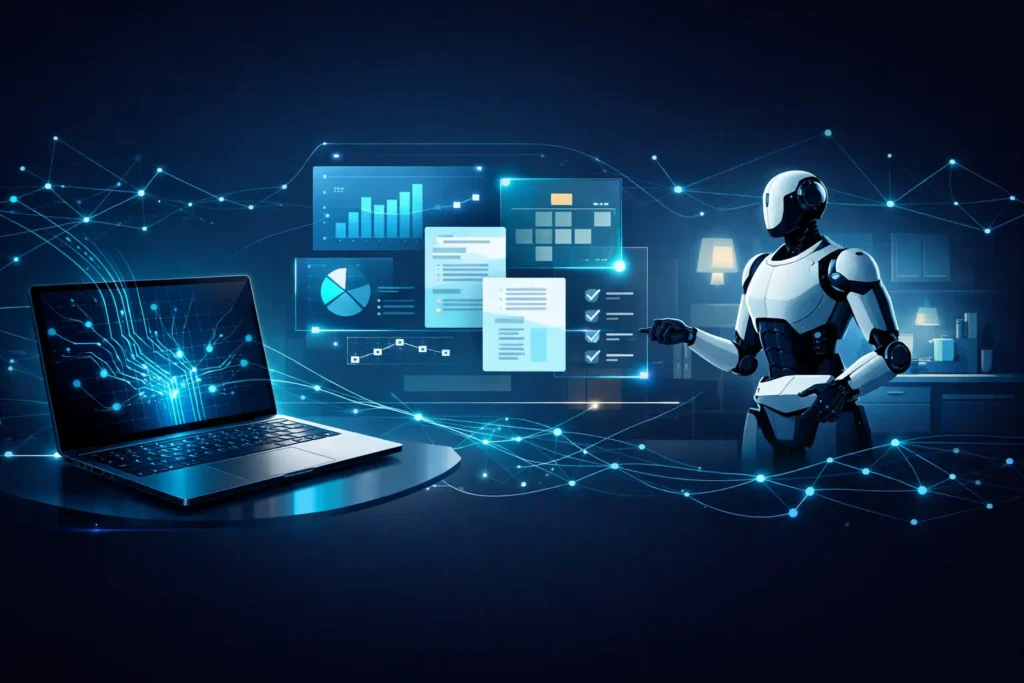
These three gadgets share a common theme: AI is moving closer to the user and the real world.
- AI PCs bring intelligence onto personal devices
- AI agents embed intelligence into everyday software
- AI robots extend intelligence into physical environments
The trend is clear. The future of tech is not about more screens or faster chips alone. It’s about systems that understand context, reduce effort, and take action.
In 2026, the most famous gadgets are not just tools you use. They are systems that work alongside you.