Artificial intelligence is evolving faster than ever—and Agentic AI is the newest breakthrough shaking up the tech world. Unlike traditional AI models that only respond when prompted, Agentic AI can plan, make decisions, take actions, and complete tasks autonomously.
In simple terms: Agentic AI doesn’t just answer you — it works for you.
This shift marks the beginning of a new era where AI becomes an active problem-solver, not just a passive tool.
In this article, we’ll break down what Agentic AI is, how it works, real-world examples, benefits, risks, and why it’s one of the most important technologies of the decade.
⭐ What Is Agentic AI?
Agentic AI refers to AI systems that can independently plan, decide, and take actions to complete tasks without needing constant human direction.
Traditional AI = You ask → AI replies
Agentic AI = You ask → AI analyzes → plans → acts → completes the task
Think of it as moving from “answer engines” to “action engines.”
These AI systems operate more like intelligent digital agents capable of:
- Setting goals
- Breaking tasks into steps
- Executing actions
- Learning from outcomes
- Adjusting their approach automatically
⭐ How Does Agentic AI Work? (Simple Breakdown)
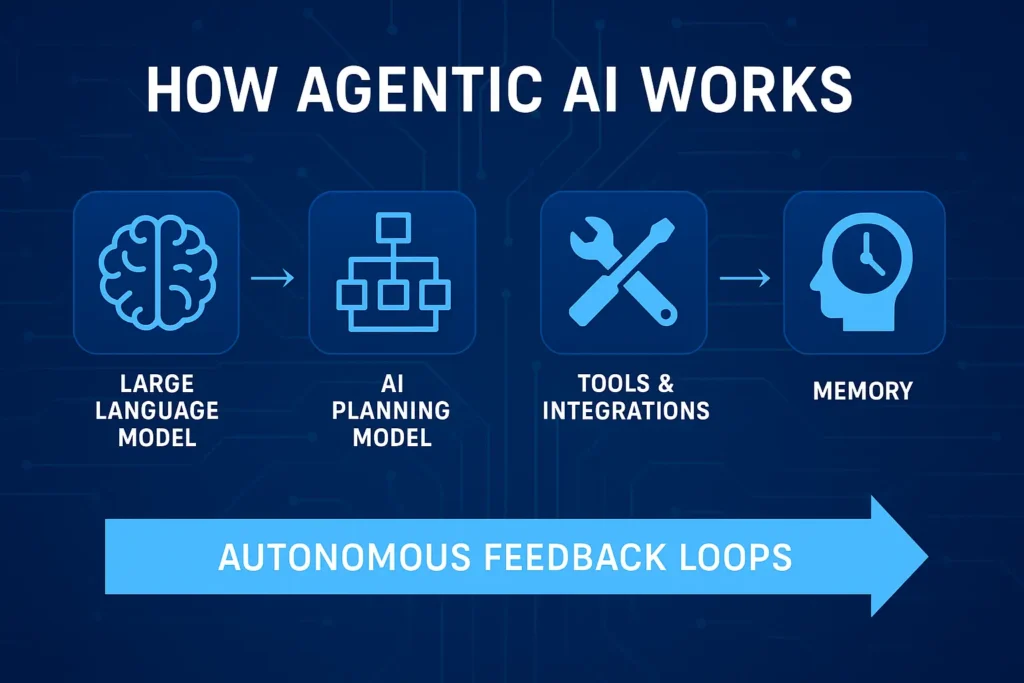
Agentic AI combines several advanced technologies:
1. Large Language Models (LLMs)
Provide reasoning, understanding, and decision-making.
2. AI Planning Models
Break tasks into smaller steps (like a to-do list).
3. Tools & Integrations
Connect with apps like email, browsers, spreadsheets, or APIs to take real-world actions.
4. Memory Systems
Store past interactions, preferences, and knowledge to improve over time.
5. Autonomous Feedback Loops
The AI checks its own output, fixes mistakes, and optimizes results.
In short:
Agentic AI = Brain (LLM) + Tools + Memory + Autonomy
⭐ Agentic AI Examples
✔ AI Assistants That Handle Your Email
Write replies, sort messages, schedule meetings.
✔ Autonomous Research Agents
Search the web, summarize findings, compile reports.
✔ AI Coding Agents
Write code, test it, debug it, and deploy updates.
✔ Task Automation Agents
Fill forms, process data, organize dashboards, manage files.
✔ AI Business Agents
Generate leads, analyze sales, draft proposals, reply to customers.
✔ Creative AI Agents
Design thumbnails, produce scripts, edit videos with minimal input.
Agentic AI is expanding into every industry—from healthcare and logistics to education and content creation.
⭐ Why Agentic AI Is a Game-Changer
1. Works Without Supervision
It doesn’t need you to guide every step. Give a goal, and it executes.
2. Saves Massive Time
Tasks that took hours now take minutes—or seconds.
3. Reduces Human Error
AI follows structured steps, checks output, and corrects mistakes.
4. Boosts Productivity Everywhere
Employees, creators, and developers can offload repetitive tasks.
5. Opens the Door to Digital Workforces
Companies can deploy autonomous “AI employees.”
6. Learns and Improves Continuously
Every task helps it get smarter and more efficient.
⭐ Agentic AI vs Traditional AI
| Feature | Traditional AI | Agentic AI |
|---|---|---|
| Response | Answers | Acts & completes tasks |
| Autonomy | Low | High |
| Memory | Often limited | Persistent |
| Decision-making | Static | Dynamic & adaptive |
| Execution | Requires human prompts | Works independently |
| Use cases | Chat, info, recommendations | Research, coding, automation, operations |
⭐ Real-World Use Cases (Happening Now)
✔ Business Operations
AI handles customer support, reporting, outreach, and analytics.
✔ Education
AI tutors that plan lessons, check homework, and personalize learning paths.
✔ Software Development
AI agents generate code, test features, fix bugs.
✔ Healthcare
AI agents analyze reports, schedule workflows, assist in diagnosis.
✔ Personal Productivity
Smart agents manage schedules, reminders, tasks, budgeting, and planning.
✔ Content Creation
AI writes drafts, researches topics, designs graphics, edits videos.
The impact will only grow as more industries adopt autonomous AI.
⭐ Risks & Challenges of Agentic AI
Although powerful, Agentic AI introduces new concerns:
1. Over-Autonomy
Too much independence can cause unintended actions.
2. Bias & Errors
Like any AI, agents can make mistakes or rely on flawed data.
3. Security Threats
Unauthorized AI actions could be dangerous without restrictions.
4. Job Displacement
Routine roles may be replaced by autonomous digital workers.
5. Ethical Issues
How much freedom should AI have? Who is responsible for errors?
Proper regulations, auditing, and human oversight are essential.
⭐ The Future of Agentic AI
We are entering a world where:
- Apps become obsolete
- AI manages digital workflows
- Companies hire AI teams
- Individuals have personal digital assistants
- Complex tasks become fully automated
Agentic AI represents the next evolution: AI that doesn’t just respond — it performs.
This new era of autonomous intelligence will reshape how humans work, learn, create, and innovate.
⭐ Final Thoughts
Agentic AI is one of the most transformative technologies of our time. By taking action autonomously, it unlocks productivity, creativity, and efficiency we’ve never seen before.
Whether you’re a business owner, developer, creator, or everyday user, understanding Agentic AI will help you stay ahead in a rapidly changing world.
⭐ FAQs
1. What is Agentic AI in simple terms?
Agentic AI is a type of artificial intelligence that can plan, make decisions, and complete tasks on its own. Unlike traditional AI that only responds to prompts, Agentic AI acts independently to achieve a goal.
2. How is Agentic AI different from regular AI?
Regular AI gives answers when asked. Agentic AI goes a step further — it analyzes the task, creates a plan, takes actions, and completes the task autonomously. It behaves more like a digital assistant that works for you instead of just replying to you.
3. What can Agentic AI do?
Agentic AI can research online, write emails, summarize information, automate workflows, create content, generate code, debug programs, schedule tasks, and integrate with apps to perform real actions. It acts like a smart automated worker.
4. Is Agentic AI safe to use?
Agentic AI is generally safe when built with proper guardrails and permissions. The main risk comes from giving AI too much autonomy without restrictions. As long as actions are monitored and access controls are in place, it is safe for everyday users and businesses.
5. Will Agentic AI replace human jobs?
Agentic AI will automate many repetitive and rule-based tasks, reducing the need for manual work. However, it also creates new opportunities for roles in AI management, oversight, engineering, design, and creative supervision. It is more likely to change jobs than fully replace them.
6. What industries benefit most from Agentic AI?
Industries such as software development, customer service, content creation, education, healthcare, data analysis, finance, logistics, and business operations benefit greatly from Agentic AI because it automates tedious tasks and increases productivity.
7. Can beginners or non-technical users use Agentic AI?
Yes. Modern Agentic AI systems are built to be user-friendly. Anyone can give instructions in natural language, and the AI handles the complex steps in the background. You don’t need coding or technical expertise.
8. What tools or platforms offer Agentic AI features today?
Some emerging platforms include:
- AI research agents
- AI automation assistants
- AI coding agents
- Workflow automation platforms
- Autonomous digital work tools
Most major AI companies are integrating agentic features into their models.
9. Is Agentic AI the future of artificial intelligence?
Many experts believe so. Agentic AI represents the shift from answer-based AI to action-based AI, making it one of the most important advancements in AI. It will likely shape future workplaces, education, and digital applications.
10. How do I start using Agentic AI today?
You can begin by trying AI tools that offer autonomous task execution, such as research agents, writing assistants, coding agents, and workflow automation tools. Start with simple tasks like drafting emails or summarizing content, then gradually use more advanced features.