Introduction
For most of software history, a program did exactly what it was told, in exactly the order it was told to do it. Machine learning loosened that a little: a model could learn a pattern instead of following a rule. Generative AI loosened it further: a model could produce something new — text, code, an image — in response to a prompt. But at each of these stages, a human was still deciding what happened next. You asked a question. The system answered. You read the answer and decided what to do about it.
Agentic AI is the stage where that loop starts to close on its own. Instead of “generate an answer,” the instruction becomes “achieve this outcome” — and the system decides, step by step, what actions get it there: which tool to call, which document to read, whether the first attempt worked, and what to try if it didn’t.
That’s a real shift, and it’s worth taking seriously without overselling it. Most “AI-powered” features shipping in 2026 are still single-shot generation or fixed retrieval pipelines wearing agentic branding. Genuine agentic behavior — a system that plans, acts, observes results, and adapts across many steps with limited supervision — is a smaller, harder, riskier category, and the evidence on how well it works in production is decidedly mixed. Enterprise surveys throughout 2026 report large gaps between how many organizations have an agent embedded somewhere in their stack and how many actually trust one running unsupervised in production.
The transition looks roughly like this: traditional software → machine learning → generative AI → AI assistants and copilots → AI agents → agentic AI, as an architectural pattern that spans single agents and coordinated multi-agent systems. This guide walks through that whole stack — what agentic AI is, how it works, which models and frameworks currently lead, what it costs, where it breaks, and where the serious evidence (not the vendor slide) says it’s actually headed.
What Is Agentic AI?
Agentic AI is an approach to building AI systems that pursue a goal through a loop of planning, tool use, and self-correction, rather than producing a single response to a single prompt. The defining trait is “agency”: the system decides its own next step based on what happened after its last one, instead of following a path a human specified in advance.
Three things look superficially similar but are not the same:
- Generating an answer. You ask “what’s a good marketing headline for this product?” The model produces text. Nothing happens in the world.
- Following a workflow. A fixed sequence of steps runs, possibly with an AI-generated field inside it, but the control flow — what happens after each step — is written by a human in advance.
- Pursuing a goal autonomously. You specify an outcome. The system decides which steps are needed, executes them through tools, checks whether they worked, and changes course if they didn’t — without a human dictating each step.
A simple example: ask a normal chatbot “what’s the cheapest flight to Delhi next week?” and it can only describe how you’d find one, because it has no way to check real prices. Give the same goal to an agent wired up with a flight-search tool, a calendar, and a payment method, and it can search live fares, compare options against your budget, and — if authorized — actually book one. The model didn’t get smarter; it got hands.
What Is an AI Agent?
An AI agent is a specific system: a foundation model plus tools, memory, and an execution loop, aimed at a goal. Agentic AI is the broader category or design philosophy; an AI agent is one instance of it.
The relationship runs: AI model → AI agent → agentic system → multi-agent system. A model is a component — it predicts outputs. Wrap it with tool access, a planning loop, and permissions, and you have an agent. Connect several specialized agents that hand off work to each other, and you have a multi-agent system.
Take the example from the introduction: “Book me a business trip to Delhi next week while staying under ₹30,000.” A conventional chatbot can only produce a plan you’d have to execute yourself — recommended flights to check, a rough budget breakdown, general advice. An agent with access to a flight-search API, a hotel-booking tool, a calendar, and payment credentials can actually search live inventory, compare combinations against the ₹30,000 constraint, flag trade-offs, and — with appropriate authorization — complete the booking, then confirm what it did. The difference isn’t intelligence; it’s whether the system can act and verify, not just describe.
How Does Agentic AI Work?
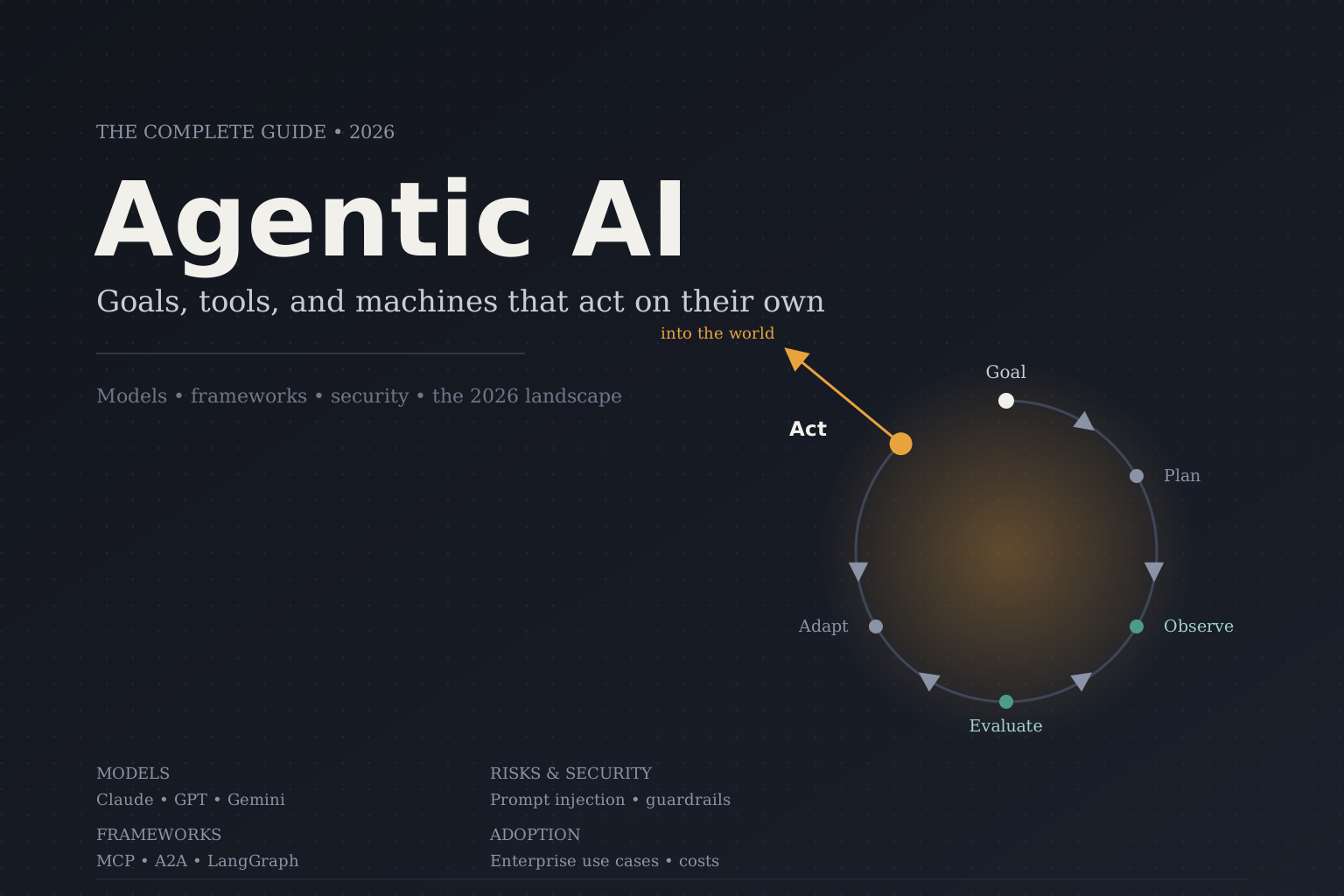
Most agent systems run some version of the same loop:
Goal
  ↓
Understand context
  ↓
Plan
  ↓
Reason
  ↓
Select tool(s)
  ↓
Take action
  ↓
Observe result
  ↓
Evaluate (did that work?)
  ↓
Adapt (revise plan if not)
  ↓
Repeat until goal is met or a stopping condition is hit
- Understand context. The agent gathers what it needs to know: the user’s instruction, relevant memory, retrieved documents, current system state.
- Plan. It breaks the goal into a rough sequence of sub-tasks — not necessarily fixed in advance, since plans commonly get revised mid-execution.
- Reason. Before or during action, the model works through what a step should accomplish and why, often visible as intermediate “thinking” or chain-of-thought-style reasoning.
- Select tools. The agent decides which function, API, or resource is relevant to the next step, and with what arguments.
- Take action. The tool call actually executes — a search runs, code executes, an email sends, a database updates.
- Observe. The agent reads back the tool’s output: search results, an error message, a file diff, an API response code.
- Evaluate. It checks the observation against the goal: did that step succeed, partially succeed, or fail?
- Adapt. If something didn’t work, the agent revises its plan — tries a different tool, a different query, or asks a human for input — rather than blindly continuing.
- Repeat until the goal is satisfied, a budget (time, tokens, cost) is exhausted, or a guardrail halts execution.
This loop is what independent researchers now use to distinguish agentic from non-agentic systems: whether control flow is fixed by application code ahead of time, or decided by the model at runtime based on intermediate results. A single function call triggered by one LLM output is not, by that definition, agentic — the loop and the runtime decision-making are what qualify it.
Core Components of Agentic AI
Foundation Model / LLM — the reasoning engine that interprets goals, plans steps, and decides what to do next.
Planning — decomposing a goal into an ordered (and often revisable) sequence of sub-tasks.
Reasoning — the model’s step-by-step working-through of a problem, including self-critique and error detection.
Tool Use — the mechanism (typically function/tool calling) by which the model invokes external capabilities: search, code execution, APIs, databases.
Memory — state that persists across steps or sessions: recent conversation, retrieved facts, past outcomes.
Context Management — deciding what information actually needs to be in the model’s context window at each step, since windows are large but not infinite and irrelevant context degrades performance.
Retrieval / RAG — pulling relevant external knowledge into context on demand, rather than relying solely on what the model memorized during training.
Environment Interaction — the actual surface the agent acts on: a browser, a filesystem, a terminal, a piece of enterprise software.
Feedback Loops — the observe-evaluate-adapt cycle that lets an agent notice and recover from failure mid-task.
Execution Layer — the runtime that actually carries out tool calls, sandboxes code, and manages concurrency.
Identity and Permissions — who (or what) the agent is acting as, and what it is and isn’t authorized to touch.
Guardrails — validation, rate limits, and policy checks that constrain what actions an agent is allowed to take.
Human Oversight — approval steps, review queues, and escalation paths that keep a person in or on the loop for consequential actions.
Agent Orchestration — the layer (framework or custom code) that coordinates multiple agents, tools, and steps into a coherent system.
These pieces are interdependent: a model with excellent reasoning but no memory will re-litigate the same mistakes every session; a model with great tools but no guardrails is a liability; an agent with perfect planning but no way to observe whether its actions worked is flying blind.
Agentic AI Architecture
Simple single-agent architecture. One model, a small tool set, minimal state. Fast to build, easy to reason about, but limited to narrow tasks.
Tool-using agent. A single agent with broad tool access (search, code execution, file I/O) but a single-pass or lightly looped control flow.
ReAct-style architecture (Reason + Act). The model alternates explicit reasoning steps with tool calls, observing results before deciding the next reasoning step — one of the original patterns that made tool-using agents reliable enough to be useful.
Planning-and-execution architecture. A planner produces a multi-step plan up front; a separate execution loop carries it out and reports back, sometimes triggering replanning.
Reflection architecture. The agent (or a second “critic” pass) reviews its own output or intermediate steps and revises before finalizing — trading extra latency and cost for higher reliability.
Multi-agent architecture. Multiple specialized agents collaborate, each with a narrower role, communicating through structured handoffs or shared state.
Hierarchical agents / supervisor-worker architecture. A top-level “supervisor” agent decomposes the goal and delegates sub-tasks to specialized “worker” agents, then integrates their results.
Parallel agents. Independent sub-agents work simultaneously on different parts of a task (e.g., researching several sources at once), reducing wall-clock time at the cost of coordination complexity.
Sequential agent workflows. Agents or steps run strictly in order, each depending on the previous one’s output — simpler to debug, but slower and less resilient to a single failed step.
Event-driven agents. Agents wake up and act in response to external events (a new support ticket, a webhook, a file upload) rather than running continuously.
Long-running agents. Designed to operate over hours, days, or longer, requiring durable state, checkpointing, and the ability to resume after interruption — an area of active competition among coding-agent vendors in 2026.
A representative single-agent diagram:
User
 ↓
Agent (LLM + control loop)
 ├── Planner
 ├── Memory
 ├── Tools
 ├── Browser
 ├── APIs
 ├── Database
 └── Execution Environment
Each architecture trades off differently: simple architectures are auditable but brittle on complex goals; multi-agent and hierarchical designs handle more complex work but multiply the surface area for coordination failures, cost, and security risk — a point security researchers have flagged specifically around “cross-agent” attacks (see the Security Risks section).
Agentic AI vs Generative AI
| Dimension | Generative AI | Agentic AI |
|---|---|---|
| Purpose | Produce content (text, image, code, audio) | Pursue and complete a goal |
| Autonomy | None beyond the single response | Multi-step, runtime-decided |
| Planning | Not required | Central to the system |
| Tool use | Optional, often absent | Core mechanism |
| Memory | Typically session-only | Often persistent across steps/sessions |
| Decision-making | Human decides what to do with the output | System decides its own next step |
| Execution | Output is descriptive | Output can include real-world actions |
| Human involvement | Reads and acts on the output | Sets the goal, may approve key actions |
| Typical output | Text, image, audio, code snippet | Completed task, side effects in other systems |
| Complexity | Lower | Higher (more moving parts, more failure modes) |
| Risk profile | Misinformation, IP, bias in content | All of that, plus unauthorized or harmful actions |
“Generative AI creates. Agentic AI acts” is a useful shorthand, but it oversimplifies: most agentic systems still generate content as part of acting (drafting an email before sending it), and the underlying model doing the “acting” is usually the same kind of generative model, just wrapped in a loop with tools. The distinction is architectural, not a difference in the model itself.
Agentic AI vs AI Assistants, Chatbots, and Copilots
| System type | What it does | Autonomy | Typical example |
|---|---|---|---|
| Chatbot | Answers questions conversationally | None to minimal | FAQ bot |
| AI assistant | Answers + performs a bounded set of actions on request | Low, mostly reactive | Voice assistant setting a reminder |
| Copilot | Suggests content inside a human’s workflow; human approves each suggestion | Low; human stays in the loop constantly | Code-completion tool |
| AI agent | Pursues a defined goal through multiple autonomous steps | Medium to high | Research agent that gathers, synthesizes, and reports |
| Agentic system (multi-agent) | Coordinates several agents toward a complex goal | High | Multi-agent software-engineering pipeline that plans, codes, tests, and opens a pull request |
The boundaries blur in practice, and vendors have strong incentives to call things “agents” that are closer to copilots. A useful check: does the system decide what to do next based on results it observes, with minimal step-by-step human direction? If not, it’s assistive, not agentic, regardless of the label.
Agentic AI vs Automation
Traditional rule-based automation (RPA, fixed workflow engines) executes a predetermined sequence: if X, then Y. It’s reliable, auditable, cheap to run, and completely predictable — which is exactly why it remains the better choice for high-volume, well-defined, rarely-changing processes (payroll runs, standardized form processing, scheduled data transfers).
Agentic AI adds value where the task is variable, the inputs are messy or unstructured, or the correct sequence of steps can’t be fully specified in advance — for example, triaging an ambiguous customer complaint that might need a refund, an escalation, or just an explanation, depending on details that vary case by case.
Automation is usually better when: the process is stable and well-defined, errors are costly and must be near-zero, and full auditability is a hard requirement. Agentic AI is usually better when: the task has genuine variability, some judgment is required, and occasional imperfect outcomes are an acceptable trade-off for handling volume or ambiguity that rigid automation can’t. Many production systems in 2026 combine both — deterministic automation for the well-defined 80%, an agent for the ambiguous remainder, with human review at the boundary.
Single-Agent vs Multi-Agent AI
| Single-agent | Multi-agent | |
|---|---|---|
| Best for | Narrow, well-scoped tasks | Complex tasks decomposable into specialized roles |
| Coordination overhead | None | Real, and often the dominant cost |
| Failure modes | Contained to one system | Can cascade or propagate across agents |
| Cost | Lower, more predictable | Higher — communication between agents itself consumes tokens |
| Observability | Simpler to trace | Harder; requires tracking cross-agent handoffs |
| Example | A single research agent that answers a question | A supervisor agent delegating to a researcher, a writer, and a fact-checker agent |
Multi-agent systems typically involve specialized agents (each tuned or prompted for a narrower role), delegation (a supervisor assigns sub-tasks), communication (structured messages or shared state passed between agents), and sometimes parallel execution (independent agents working simultaneously, later merged by a coordinator). Frameworks differ sharply on how much of this they make explicit versus automatic — a distinction covered in the frameworks section below.
The trade-off is real: multi-agent systems can tackle harder problems and parallelize work, but they multiply token cost, add coordination failure modes (agents talking past each other, redundant work, runaway “conversation” loops between agents with no clear termination condition), and expand the attack surface for prompt injection and cross-agent manipulation.
How AI Agents Use Tools
Tool calling — often standardized today via function calling and increasingly via the Model Context Protocol (covered below) — is the mechanism that turns a text-generating model into something that can act. Common tool categories include:
- APIs — the general mechanism for reaching almost any external service.
- Web search and browsing — for information the model wasn’t trained on or that changes over time.
- Browsers (computer use) — agents that can click, type, and navigate a UI the way a person would, useful when no API exists.
- Databases — structured queries against internal or external data.
- Code execution — running generated code in a sandbox to compute, test, or transform data.
- File systems — reading, writing, and editing files (central to coding agents).
- CRM systems — pulling and updating customer records.
- Email and calendars — reading and sending messages, scheduling.
- Payment systems — completing transactions, a category with unusually high stakes.
- Enterprise software — ERPs, ticketing systems, internal dashboards.
- Cloud infrastructure — provisioning, deploying, and configuring systems.
Tool access is precisely what makes agents useful and precisely what makes them dangerous. A model that can only generate text can, at worst, produce a bad or misleading sentence. A model wired to send emails, run shell commands, or move money can produce a bad or misleading action — and every tool added is a new potential vector for prompt injection, a new set of permissions to scope correctly, and a new thing that needs monitoring and rollback. This trade-off — capability scales with tool access, and so does risk — is the throughline of most serious agent-security research published in 2025–2026 (see Security Risks, below).
Memory in Agentic AI
- Short-term / working memory — what’s actively in the model’s context during the current task.
- Long-term memory — information retained across sessions, typically stored externally and retrieved on demand.
- Episodic memory — records of specific past interactions or task episodes (“last time, this approach failed”).
- Semantic memory — general facts and knowledge, often held in a vector database for retrieval.
- Vector databases — the common infrastructure for storing embeddings so relevant memories or documents can be retrieved by similarity rather than exact match.
- Context windows — the finite space the model can attend to at once; increasingly large (multiple providers now offer windows in the hundreds of thousands to over a million tokens) but not a substitute for well-managed memory, since stuffing everything into context degrades focus and raises cost.
- Persistent state — the record of where a long-running task currently stands, essential for agents that operate over hours or days and need to resume after interruption.
Memory matters most for long-running or repeated-use agents: without it, an agent re-derives the same context and repeats the same mistakes every session. It also introduces a distinct security concern researchers call memory poisoning — an attacker corrupting what an agent “remembers” so that future, unrelated tasks are subtly compromised (see Security Risks).
Reasoning and Planning in Agentic AI
Task decomposition breaks an ambiguous goal into concrete, actionable sub-tasks. Planning orders those sub-tasks, sometimes as a rigid upfront plan, more often as a living plan that gets revised. Reasoning is the model’s step-by-step process of working through what a given step should accomplish, frequently made visible as extended “thinking” traces in current reasoning-tuned models. Replanning happens when execution reveals the original plan won’t work. Reflection is a deliberate self-review pass, where the model (or a separate critic instance) checks its own work before proceeding. Self-evaluation asks whether an action actually achieved its intended effect, not just whether it executed without an error. Error recovery is the ability to notice a step failed and try something else, rather than repeating the same failing action or silently proceeding as if it worked.
The core distinction from ordinary generation: a plain LLM call produces one answer and stops, right or wrong. An agentic loop keeps checking whether it’s actually making progress toward the goal — and that self-monitoring, more than raw model capability, is what separates a system that reliably completes a task from one that occasionally does.
Top Agentic AI Models in 2026
Model naming and pricing move quickly; the specifics below reflect publicly reported information as of mid-to-late 2026 and should be checked against each provider’s current documentation before being used for procurement decisions. Figures for benchmarks like SWE-bench, OSWorld, and GDPval come from vendor-published results and third-party evaluations, which use different methodologies — treat cross-vendor comparisons as directional, not exact.
| Model family | Company | Notable for agentic work | Context window | Tool/function calling | Computer use | Open or proprietary |
|---|---|---|---|---|---|---|
| Claude (Sonnet 5, Opus 4.8, Haiku 4.5) | Anthropic | Coding agents, computer use, sustained multi-step tasks; Claude Code is a leading agentic coding product | Up to 1M tokens (beta on some models) | Native, mature | Strong (OSWorld-Verified scores in the 70–80%+ range reported across recent releases) | Proprietary |
| Claude Mythos 5 / Fable 5 | Anthropic | New top tier above Opus, aimed at long-horizon agentic tasks; access briefly suspended mid-2026 for export-control compliance, then restored | Very large (reported) | Native | Reported strong | Proprietary |
| GPT-5.6 family (Sol, Terra, Luna) | OpenAI | Frontier coding/agentic tier (Sol), balanced (Terra), low-cost (Luna); strong on Coding Agent Index, Terminal-Bench 2.1 | Large (100K+ tokens typical) | Native, mature (Agents SDK, Responses API) | Supported via agent tooling | Proprietary |
| Gemini 3.1 Pro / 3.5 Flash | Google DeepMind | Backbone for Google Antigravity agent-first IDE; 3.5 Flash optimized for fast, high-volume agent workflows | Large | Native | Paired with dedicated Gemini computer-use model | Proprietary |
| DeepSeek V4 | DeepSeek | Best reported performance-to-inference-cost ratio for self-hosted agentic deployment | Large | Yes | Limited/emerging | Open-weight |
| Kimi K2.6 | Moonshot AI | Strong sub-agent/specialist role in multi-agent pipelines; long-horizon multi-step tool execution | 256K tokens (reported) | Yes, including “agent swarm” mode | Limited | Open-weight |
| Qwen 3.6 (incl. Plus) | Alibaba | Leading open-weight choice for demanding agentic coding; 1M-token context reported | Up to 1M tokens (reported) | Yes | Limited | Open-weight |
| GLM-5.1 | Z.ai (Zhipu) | Competitive on coding benchmarks; MIT license attractive for enterprise fine-tuning | Large | Yes | Limited | Open-weight |
Do not treat this table as exhaustive or as a permanent ranking — the frontier reshuffles roughly every few months in 2026, and open-weight models from Chinese labs (DeepSeek, Moonshot/Kimi, Alibaba/Qwen, Z.ai/GLM) have closed much of the gap with closed frontier models on agentic coding and tool-use benchmarks specifically, even where they still trail on generalization to genuinely novel tasks. Specifications, pricing, and benchmark scores may have changed since publication and should be checked against each provider’s current documentation.
Best AI Models by Use Case
These rankings synthesize benchmark results and practitioner reporting as of mid-2026; they are inherently more subjective than the raw model table above, and reasonable people weighting cost, latency, or a specific benchmark differently would rank them differently.
Best Overall Agentic AI Model: Frontier-tier models from Anthropic (Opus-class/Mythos-class) and OpenAI (GPT-5.6 Sol) are consistently reported at or near the top across coding, computer-use, and knowledge-work benchmarks; Google’s Gemini 3.x line is competitive, particularly when paired with Antigravity.
Best for Coding Agents: Claude models (via Claude Code) and GPT-5.6 Sol lead on SWE-bench-style evaluations in most third-party comparisons published in 2026, with open-weight Kimi K2.6, Qwen 3.6, and GLM-5.1 close behind on several coding leaderboards.
Best for Computer Use: Anthropic’s Sonnet/Opus line and Google’s dedicated computer-use model (paired with Gemini 3.x in Antigravity) report the strongest OSWorld-Verified scores among publicly compared models.
Best for Research Agents: Models with strong tool use plus long context — Gemini 3.1 Pro, Claude Opus-class, and GPT-5.6 Terra/Sol — perform well on GAIA-style multi-step information-seeking tasks; results vary considerably by the surrounding agent scaffold, not model alone.
Best for Enterprise Agents: Claude Sonnet 5, GPT-5.6 Terra, and Gemini 3.1 Pro are the most commonly cited defaults for production enterprise deployments, prioritized for reliability and cost-predictability over raw peak capability.
Best Open-Weight Model: Qwen 3.6 Plus and Kimi K2.6 are the most frequently cited leaders for agentic coding among open-weight options in 2026 evaluations, with DeepSeek V4 favored specifically for self-hosted cost efficiency.
Best for Cost Efficiency: Claude Haiku 4.5, GPT-5.6 Luna, and self-hosted DeepSeek V4 are the models most often recommended when cost per task matters more than peak capability.
Best for Long Context: Several 2026-era models (from Anthropic, Qwen, and others) report context windows up to or near 1 million tokens; practical usefulness at that scale still depends heavily on the surrounding retrieval and context-management design, not window size alone.
Best for Multimodal Agents: Gemini 3.x and Claude’s current generation both support strong multimodal input (text, image, and in Gemini’s case video) integrated into agentic workflows.
Best for Complex Reasoning: Reasoning-focused evaluations like Humanity’s Last Exam are led at different points in 2026 by Anthropic, OpenAI, and Kimi K2-family models depending on the exact benchmark variant and tool access allowed — treat any single “winner” claim here skeptically, since rankings shift release to release.
Do not choose a model purely because a vendor markets it as “agentic” — check independent evaluations, and where possible test on your own workload, since benchmark performance and real-world agent reliability correlate imperfectly (a point raised explicitly in 2026 agent-reliability research, discussed below).
Top Agentic AI Platforms and Frameworks
| Framework/Platform | Maintainer | Orchestration model | Best fit |
|---|---|---|---|
| LangChain / LangGraph | LangChain | Graph-based, explicit nodes and edges | Production systems needing auditability, state persistence, and human-in-the-loop interrupts |
| CrewAI | CrewAI | Role-based “crews” (sequential or hierarchical) | Fast prototyping of workflows that map to human team roles |
| AutoGen | Microsoft (now largely superseded) | Conversational multi-agent | Iterative, exploratory tasks; Microsoft has shifted primary investment to the newer Microsoft Agent Framework |
| Microsoft Agent Framework | Microsoft | Enterprise-oriented orchestration, Azure-integrated | Enterprises standardized on Azure/Microsoft stack |
| OpenAI Agents SDK | OpenAI | Explicit “handoffs” between agents | Teams building on OpenAI’s model and tooling stack |
| Google ADK (Agent Development Kit) | Optimized for Gemini, supports A2A interoperability | Teams building on Google Cloud/Gemini | |
| LlamaIndex | LlamaIndex | RAG-centric agent construction | Retrieval-heavy agentic systems |
| Semantic Kernel | Microsoft | SDK for embedding agents into existing enterprise apps | .NET/enterprise-integration-heavy environments |
By mid-2026, LangGraph had reportedly overtaken CrewAI in developer adoption signals (e.g., GitHub activity) largely on the strength of its explicit, auditable graph model, which maps well onto enterprise requirements for rollback points and compliance logging. AutoGen’s active development has substantially shifted to Microsoft’s newer Agent Framework, leaving the original AutoGen largely in maintenance mode — a useful reminder that this ecosystem is still consolidating and today’s popular framework is not guaranteed to be tomorrow’s. A contrarian view worth noting: some practitioners argue that as frontier models gain native long-running orchestration and tool-calling capability, heavy external scaffolding may matter less over time than it does today — a genuinely open debate, not settled fact.
Model Context Protocol (MCP) and Agentic AI
MCP is an open protocol, introduced by Anthropic in November 2024, that standardizes how AI models connect to external tools, data sources, and services — replacing the old pattern where every application needed a custom, one-off integration for every model-tool pairing. An MCP server exposes a set of tools, resources, and prompts that any MCP-compatible client (a chat app, an IDE, an agent framework) can discover and use without bespoke integration code.
MCP’s adoption has been unusually fast and broad: reported figures put SDK downloads at roughly 97 million per month and the public server registry at over 9,000 entries by mid-2026, with native support from Anthropic, OpenAI, Google DeepMind, and Microsoft. In December 2025, Anthropic donated MCP’s governance to the newly formed Agentic AI Foundation (AAIF), a directed fund under the Linux Foundation co-founded by Anthropic, Block, and OpenAI, with AWS, Google, Microsoft, Cloudflare, and Bloomberg as additional platinum members — a move widely read as the decisive signal that made MCP safe for large enterprises to standardize on, since no single vendor now controls the spec.
MCP matters for agentic AI specifically because it decouples “which model” from “which tools” — a PostgreSQL or GitHub MCP server built once works with Claude, GPT, Gemini, or a self-hosted open-weight model, without rebuilding the integration for each. That same openness is also the protocol’s biggest emerging security concern: MCP servers can be poisoned, over-permissioned, or connected to untrusted content, and a significant share of deployed servers reportedly still rely on static credentials rather than proper OAuth-based authorization — a gap actively being addressed in the 2026 protocol roadmap (see Security Risks for specific incidents tied to MCP infrastructure).
Agent-to-Agent Communication
Where MCP standardizes how an agent talks to a tool, A2A (Agent2Agent), introduced by Google in April 2025, addresses how one agent discovers, authenticates with, and delegates work to another — potentially built by a different vendor entirely. The distinction matters architecturally: a tool is a passive capability provider with no independent reasoning, while a peer agent has its own planning, state, and autonomy, so treating an agent as if it were a tool loses that agent’s ability to maintain its own task lifecycle and authentication context.
Core pieces of the emerging agent-to-agent stack include:
- Agent discovery — finding what agents exist and what they’re capable of.
- Delegation — handing off a sub-task to another agent and receiving results back.
- Communication — a structured message format for task requests and responses.
- Authentication and authorization — verifying which agent is acting on whose behalf, and what it’s allowed to do.
- Interoperability — enabling agents from different frameworks or vendors (e.g., a LangGraph agent and an ADK agent) to work together through a common interface.
A2A is now co-governed alongside MCP under the AAIF, and the broader protocol landscape has continued to expand in 2026 with adjacent standards for commerce (the Agentic Commerce Protocol) and machine-to-machine payments (x402) — evidence that the industry is converging on the idea that a functioning “agent economy” needs shared rails for discovery, delegation, and payment, not just a shared way to call tools. This remains an early, actively evolving layer; expect continued consolidation and likely friction as commercial incentives compete with genuine interoperability.
Real-World Applications of Agentic AI
Coverage here is organized by how far each application has actually progressed, not how far vendors say it’s progressed.
In production at meaningful scale: coding assistance and agentic software engineering (see below); customer-support triage and resolution for well-scoped queries; sales development (lead research and outreach drafting); IT operations (routine ticket triage, access requests); document processing and data extraction.
Widely piloted, mixed production results: research and competitive-analysis agents; finance operations (reconciliation, reporting drafts); HR (candidate screening support, onboarding workflows); e-commerce (personalized recommendation and support agents); marketing content and campaign operations.
Early/prototype stage: autonomous scientific research agents; end-to-end legal document review and negotiation; fully autonomous supply-chain re-planning; healthcare diagnostic-support agents operating with minimal clinician oversight (heavily constrained by regulation, appropriately).
Largely speculative or future-facing: fully autonomous “AI employees” replacing entire job functions end-to-end; large-scale agent-to-agent commerce operating without human transaction review; robotics agents performing open-ended physical tasks at the reliability level of their software counterparts.
Cybersecurity deserves a specific callout: agentic AI is being used defensively (automated vulnerability discovery, faster patch generation) and, per documented 2025–2026 incidents, offensively — including a state-sponsored campaign in which hijacked coding-agent instances reportedly handled 80–90% of an espionage operation’s tactical steps autonomously (see Security Risks). This is one of the clearest cases where “real-world application” and “real-world risk” are the same phenomenon viewed from opposite sides.
Agentic AI in Software Development
This is, by most available evidence, the area where agentic AI has achieved the most genuine production traction. Coding agents built on frontier models (Anthropic’s Claude Code, OpenAI’s Codex-line tooling, Google’s Antigravity, and open-weight alternatives via Qwen3-Coder and Kimi K2) now routinely handle:
- Code generation across full features, not just autocomplete-scale snippets.
- Repository understanding — reading and reasoning about large, unfamiliar codebases before making changes.
- Debugging — reproducing an issue, forming a hypothesis, and testing a fix.
- Testing — writing and running test suites against generated or modified code.
- Refactoring — restructuring code while preserving behavior, an area vendors specifically highlight for token efficiency gains.
- Pull requests and Git operations — branching, committing, and opening PRs autonomously.
- Issue resolution — the task measured by SWE-bench, where agents read a GitHub issue and a codebase snapshot and must produce a working fix.
- CI/CD and deployment — some agents now operate inside pipeline steps, though this remains a higher-risk, more supervised use case.
- Code review — flagging issues in human- or AI-written code before merge.
Reported SWE-bench Verified and SWE-bench Pro scores climbed substantially through 2025–2026 across the frontier labs, and computer-use benchmarks like OSWorld-Verified show similarly steep trajectories. That said, benchmark gains have outpaced gains in the harder-to-measure quality of reliability: independent 2026 research explicitly found that “recent capability gains have translated into only small reliability improvements” — meaning an agent that resolves more issues on a benchmark doesn’t necessarily fail less unpredictably in production. Security researchers have also flagged coding agents specifically as the largest and fastest-growing category of newly discovered agentic-AI vulnerabilities in 2026, precisely because they combine broad tool access (shell, filesystem, network) with exposure to untrusted external content (issues, PRs, dependencies).
Agentic AI in Business
Businesses are deploying agents for customer service, sales development and lead qualification, internal research, finance operations (reconciliation, expense processing, reporting drafts), HR (screening support, onboarding), internal IT support, reporting and dashboards, document processing, and general workflow automation glue between existing systems.
The idea of an “AI employee” — a persistent, named agent doing a defined job — has genuine marketing appeal and some genuine substance (a support agent that handles routine tickets around the clock is a real capability), but it should be treated critically. Current agents are strongest at well-bounded, high-volume, low-ambiguity work with clear success criteria; they remain weaker at judgment calls that require accountability, nuanced context a human colleague would pick up implicitly, or navigating genuinely novel situations. Where agents create clear value: routine, repetitive, well-specified tasks at volumes that would require significant headcount to handle manually. Where humans remain necessary: final accountability for consequential decisions, situations requiring genuine judgment or empathy, and anything where the cost of an undetected error is high and hard to reverse.
The adoption data reflects this split. By multiple 2026 surveys, a large majority of enterprises have embedded an agent somewhere in their software stack, but a much smaller share run one in unsupervised production at scale, and independent estimates of pilot-to-production conversion vary widely (from roughly one in three to under one in ten, depending on the survey and how “success” is defined) — a gap this guide returns to in the Limitations and Economics sections.
Benefits of Agentic AI
- Automation of genuinely complex, multi-step workflows that fixed rule-based automation can’t handle because the correct sequence of steps varies by case.
- Productivity gains on tasks that combine research, drafting, and execution — reported enterprise time-savings estimates for AI-assisted work run from tens of minutes to several hours per user per day, though these are self-reported and vary widely by role.
- Scalability — an agent can handle far more simultaneous cases than proportional headcount growth would allow, for tasks within its competence.
- Extended availability for tasks that don’t require synchronous human judgment.
- Personalization at scale, tailoring responses or actions to individual context without manually authoring every variant.
- Faster execution of tasks that involve significant “wait time” in a human workflow (searching, cross-referencing, drafting).
- Reduced repetitive work, freeing people for judgment-heavy tasks.
- Better software integration — agents can bridge systems that were never designed to talk to each other.
- Continuous monitoring of conditions that would be impractical for a human to check constantly.
- Multi-step task execution without requiring a human to manually chain individual actions together.
These benefits are real where the underlying task genuinely fits an agent’s strengths — bounded, checkable, tolerant of occasional imperfect outcomes. They are not universal, and vendor claims of blanket productivity multipliers should be treated with the same skepticism as any other vendor benchmark.
Limitations of Agentic AI
- Hallucination — agents can confidently take action based on incorrect beliefs, not just state incorrect facts.
- Poor planning and reasoning failures — plans that look sound but miss a critical dependency or constraint.
- Tool misuse — calling the wrong tool, with wrong arguments, or in the wrong sequence.
- Incorrect or unintended actions — the sharpest difference from generative AI: a bad output is a bad sentence; a bad action can be a sent email, a deleted file, or a wrong purchase.
- Context limitations — even large windows degrade in effective attention as they fill, and irrelevant context can actively hurt performance.
- Memory errors — stale, corrupted, or incorrectly retrieved memories propagating into new decisions.
- Cost — a single successfully completed task can require dozens to hundreds of underlying model and tool calls.
- Latency — multi-step loops with tool calls and reflection passes are inherently slower than a single generation.
- Reliability — 2026 research explicitly finds that agent reliability (consistency across repeated runs, graceful degradation, bounded error severity) lags behind raw capability gains; a model can look excellent on a benchmark average while still failing unpredictably on specific runs.
- Evaluation difficulty — traditional accuracy metrics don’t capture whether an agent took a sound path to the right answer, or got lucky.
- Lack of true understanding — agents can execute plausible-looking multi-step behavior without any grounded model of the underlying situation, which is part of why they fail unpredictably outside their training distribution.
- Dependency on external systems — an agent is only as reliable as the tools, APIs, and data sources it depends on.
- Model unpredictability — the same prompt and tools can, and sometimes do, produce different action sequences run to run.
The single most important point in this section: an AI system that can only generate text is bounded in how much damage a bad output can do. An AI system that can act — send messages, move money, modify infrastructure, delete data — is bounded only by its permissions and the guardrails around it. That’s why security deserves its own, much longer treatment.
Security Risks of Agentic AI
Security research on agentic AI moved from largely theoretical in 2024–2025 to documented, CVE-numbered, and in some cases nation-state-attributed by 2026. This section covers the major risk categories with specific, dated evidence rather than generic warnings.
Prompt injection and indirect prompt injection. Malicious instructions embedded in content an agent processes — a webpage, a file, an email, a GitHub issue — can hijack the agent’s behavior against the user’s actual intent. This remains, per the OWASP GenAI Security Project’s 2026 report, the central driver of agentic AI security failures in production. Independent researcher Simon Willison’s “lethal trifecta” framing — an agent that combines access to untrusted content, access to private data, and the ability to communicate externally — has become a standard way to reason about when an agent is exposed to this class of attack.
Documented incidents and vulnerabilities (2025–2026):
- A Chinese state-sponsored group (tracked as GTG-1002) hijacked Claude Code instances in a campaign detected by Anthropic in September 2025, targeting roughly 30 organizations across defense, energy, and technology sectors; the AI reportedly handled 80–90% of tactical operations autonomously, the first documented large-scale cyberattack run with minimal human intervention. The operators posed as legitimate security researchers to bypass the model’s safety training.
- Between December 2025 and February 2026, an attacker reportedly used Claude Code and a GPT-4.1-class model to breach multiple Mexican government agencies, exfiltrating hundreds of millions of taxpayer and civil records, again by falsely claiming an authorized bug-bounty context.
- A critical vulnerability in Anthropic’s
claude-code-actionGitHub Action (disclosed January 2026 by researcher RyotaK) allowed unauthenticated external actors to inject malicious content into CI/CD workflows; Anthropic shipped remediations inclaude-code-actionv1.0.94 and theclaude-codepackage v1.0.93. - CVE-2026-22708 against Cursor allowed an attacker to poison an agent’s execution environment so that “allowlisted” commands delivered arbitrary payloads — illustrating that allowlisting alone is not a sufficient guardrail.
- A March 2026 supply-chain compromise of LiteLLM (a widely used LLM gateway underlying CrewAI, DSPy, Microsoft GraphRAG, and other agent frameworks) pushed a backdoored package to PyPI that was downloaded roughly 47,000 times in a three-hour window before removal, reportedly propagated by an autonomous exploitation bot rather than manual attacker effort.
- A 2026 red-teaming study (“Agents of Chaos”) had 20 researchers interact over two weeks with autonomous agents holding persistent memory, email, chat, filesystem, and shell access, documenting 11 case studies including unauthorized compliance with instructions from non-owners, sensitive data disclosure, destructive actions, identity spoofing, and unsafe-behavior propagation across agents.
Other structural risk categories: tool poisoning (a malicious or compromised tool/MCP server misleading the agent); excessive permissions (agents granted far more access than a given task requires); credential theft and data exfiltration (an agent tricked into leaking secrets it can read); unauthorized transactions (financial or system-state changes taken without proper authorization); privilege escalation; agent hijacking (redirecting an agent’s goal entirely); malicious “skills” or plugins distributed through agent marketplaces; supply-chain attacks against the packages and dependencies agent frameworks rely on; memory poisoning (corrupting what an agent persistently “remembers”); cross-agent attacks (a compromised agent influencing peer agents in a multi-agent system); goal manipulation; and, more generally, the risk that comes simply from granting a system more autonomy than its actual reliability can currently support.
A 2026 enterprise survey found 88% of organizations running AI agents reported a confirmed or suspected security incident in the prior year, while only about 6% of security budgets were allocated specifically to AI agent security — a gap between deployment speed and security investment that most of the incidents above trace back to directly.
Agentic AI Safety and Guardrails
Organizations deploying agents safely in 2026 generally combine several layers rather than relying on any single control:
- Human-in-the-loop (approval required before a consequential action executes) and human-on-the-loop (a human monitors and can intervene, but doesn’t approve every step) — chosen based on how reversible and consequential the action is.
- Approval workflows for specific high-risk action types (payments, data deletion, external communications).
- Sandboxing — running agent-executed code or actions in isolated environments that limit blast radius if something goes wrong.
- Least-privilege access — granting an agent only the permissions its specific task requires, not broad standing access.
- Tool restrictions — scoping which tools an agent can call at all, and under what conditions.
- Rate limits — bounding how much an agent can do in a given time window, limiting the damage of a runaway loop.
- Authentication and authorization — verifying agent identity and enforcing what it’s allowed to touch, ideally via proper OAuth-style flows rather than static, broadly-scoped credentials (a documented weak point in a large share of deployed MCP servers).
- Monitoring, logging, and audit trails — a complete record of what an agent did, in what order, and why, which is both a security necessity and, increasingly, a regulatory requirement.
- Output and action validation — checking that a proposed action is plausible and within bounds before it executes, not just checking that it doesn’t error out.
- Kill switches — a reliable, tested way to halt an agent immediately.
- Policy enforcement — codified rules about what an agent may never do, enforced independently of the model’s own judgment.
- Agent identity — treating each agent as a distinct, auditable identity in access-control systems, rather than an anonymous extension of a human user’s permissions.
The consistent lesson from the 2025–2026 incident record is that most real breaches weren’t exotic zero-days in the model itself — they were “composability” failures: over-permissioned agents, credentials sitting in accessible config files, glue code with no validation, and features documented as “not hardened against prompt injection” being used outside their intended trust boundary. Guardrails matter more than model choice for most organizations’ actual risk exposure.
How to Evaluate an AI Agent
Standard LLM benchmarks (measuring single-turn output quality) are insufficient for agents because they don’t capture multi-step reliability, tool-use correctness, or recovery from failure. Agent-specific evaluation typically considers:
- Task completion / success rate — did the agent actually achieve the goal, end to end?
- Tool-call accuracy — right tool, right arguments, right sequence.
- Reliability — consistency across repeated runs of the same task, not just average-case performance.
- Cost per task — total tokens and tool-call cost to reach completion.
- Latency — wall-clock time to completion.
- Recovery rate — how often the agent successfully corrects course after a failed step.
- Error rate and error severity — not just whether errors happen, but how bad they are when they do.
- Safety and security — resistance to prompt injection and unsafe action execution under adversarial conditions.
- Human intervention rate — how often a human had to step in to keep the task on track.
Relevant public benchmarks include SWE-bench (and SWE-bench Verified/Pro) for software-engineering agents, GAIA for general-assistant tasks requiring web browsing and tool use, OSWorld and Terminal-Bench for computer-use and terminal agents, τ-bench (and τ²-bench) from Princeton/Sierra for policy-compliant, multi-turn service-agent tasks, and WebArena/Mind2Web for web-navigation agents. A 2026 meta-analysis (the Holistic Agent Leaderboard) evaluating over 21,000 agent rollouts across nine models and nine benchmarks found that higher “reasoning effort” settings actually reduced accuracy in a majority of runs studied — a useful reminder not to assume more compute always means better outcomes — and separate 2026 reliability research found that capability gains across model generations have translated into only modest reliability gains, meaning benchmark leadership and real-world dependability are related but distinct things. Do not treat any single benchmark score as proof of real-world superiority; test on your actual workload wherever possible.
How Much Does Agentic AI Cost?
Agentic AI cost has several layers beyond the headline per-token model price: model/API costs (which now range roughly from under $0.25 per million input tokens for the cheapest small models to over $20 per million input tokens for the most expensive frontier “Pro” tiers, with output tokens typically priced several times higher than input); tool and search costs (many web search and specialized-API tools bill per call); infrastructure (sandboxes, execution environments, orchestration hosting); vector databases and retrieval infrastructure; observability and tracing tooling; human supervision (the actual cost of the people reviewing, approving, or correcting agent output); and the compounding effect of long-running or multi-agent tasks, where a single completed task can involve dozens to hundreds of underlying model and tool calls rather than one.
That compounding is the single biggest reason agent costs surprise teams: a task that would cost a few cents as a single LLM call can cost dollars once it becomes a multi-step, multi-agent, tool-calling loop with retries and reflection passes — and multi-agent architectures specifically multiply this, since inter-agent “chatter” itself consumes tokens with no direct task-completion value. One documented case in a 2026 industry report described a logistics agent’s uncontrolled conversational loop overrunning its expected budget by roughly 40%, underscoring why hard token/step ceilings are treated as a baseline safeguard rather than an optional optimization. These figures are illustrative examples from specific reported cases, not universal prices — always model your own token volume and call patterns before budgeting.
How to Build an Agentic AI System
- Define the goal precisely enough that “success” is checkable, not just describable.
- Choose the model based on the task’s actual requirements (coding, computer use, long context, cost sensitivity) rather than headline benchmark rankings alone.
- Define tools — the minimum set the task genuinely requires, not the maximum available.
- Design permissions using least privilege from the start, not as an afterthought.
- Implement memory appropriate to the task’s time horizon — session-only for short tasks, persistent and retrievable for long-running ones.
- Implement planning — decide whether a fixed upfront plan or a dynamically revised one fits the task’s variability.
- Build the execution loop — the observe/evaluate/adapt cycle that actually makes the system agentic rather than a single tool call.
- Add guardrails — approval gates, rate limits, sandboxing, and validation before any consequential action.
- Add observability — comprehensive logging of every step, tool call, and decision, from day one.
- Evaluate against task-specific success criteria, not generic benchmarks.
- Test adversarially — specifically probe for prompt injection and unsafe action sequences before deployment, not after an incident.
- Deploy gradually — start with human-in-the-loop approval on all consequential actions, and only reduce oversight as reliability is demonstrated over time.
- Monitor continuously — agent behavior can drift as the underlying model, tools, or data sources change.
A minimal conceptual architecture for step 7 onward mirrors the loop diagram earlier in this guide: goal → plan → tool call → observation → evaluation → adaptation → repeat, wrapped in guardrails and logging at every stage.
Popular Agentic AI Use Cases for Developers
- Research agent — gathers, cross-references, and synthesizes information from multiple sources into a structured answer.
- Coding agent — plans, writes, tests, and revises code against a defined goal or issue.
- Customer-support agent — triages and resolves common requests, escalating ambiguous or high-stakes cases.
- Personal assistant agent — manages scheduling, email triage, and routine task coordination.
- Sales agent — researches leads, drafts outreach, and tracks follow-up.
- Data-analysis agent — cleans, analyzes, and visualizes data, then explains findings.
- Web automation agent — navigates and interacts with websites lacking a usable API.
- Document-processing agent — extracts, classifies, and routes information from unstructured documents.
- Business intelligence agent — monitors metrics and proactively surfaces anomalies or trends.
- Multi-agent research system — a supervisor agent delegating sub-questions to specialist research agents and synthesizing their findings.
Latest Agentic AI Developments in 2026
- February 2026 — Anthropic ships Claude Opus 4.6, then Claude Sonnet 4.6. Opus 4.6 introduced agent teams and a 1M-token context window; Sonnet 4.6 followed with connectors, skills, and context compaction extended to all users, topping the GDPval-AA benchmark at the time. Why it matters: frontier-model agentic upgrades were shipping roughly every one to two months through early-mid 2026, compressing the useful shelf life of any single model comparison.
- March 2026 — MCP publishes its post-donation 2026 roadmap under the Agentic AI Foundation, prioritizing authorization improvements after security researchers flagged widespread reliance on static credentials across deployed MCP servers. Why it matters: the dominant agent-tool protocol moving its security posture forward under multi-vendor governance, rather than one company’s roadmap.
- March 2026 — A backdoored LiteLLM package is pushed to PyPI via a compromised CI token, propagated by an autonomous exploitation bot with minimal human direction, and downloaded roughly 47,000 times in three hours. Why it matters: one of the clearest documented cases of agentic-style automation being used on the attacker side of the supply chain, not just the defender side.
- April 2026 — Kimi K2.6 and Qwen 3.6 releases narrow the open-weight/closed-model gap further on agentic coding and tool-use benchmarks. Why it matters: enterprises gain credible self-hostable alternatives for agentic workloads where data residency or cost rules out closed frontier APIs.
- May 2026 — Google I/O 2026 frames the year as “the agentic era,” launching Gemini 3.5 Flash, Antigravity 2.0, and Managed Agents in the Gemini API (hosted, single-API-call agent environments with isolated execution). Why it matters: a major lab explicitly repositioning its entire developer platform around agents-as-a-service rather than models-as-an-API.
- May 7, 2026 — EU co-legislators reach the “Digital Omnibus on AI” agreement, later formally entering into force July 27, 2026, adjusting parts of the AI Act’s high-risk compliance timeline while leaving Article 50 transparency obligations (effective August 2, 2026) and GPAI systemic-risk obligations untouched. Why it matters: the first major regulatory framework to explicitly treat multi-agent systems as a single regulated system for liability purposes.
- June–July 2026 — OWASP’s State of Agentic AI Security and Governance v2.01 catalogs CVEs and breach reports across nearly every agentic risk category, a marked shift from its 2025 predecessor’s largely theoretical threat catalog. Why it matters: agentic AI security moved from speculative to empirically documented within about a year.
- June–July 2026 — Claude Sonnet 5 and Opus 4.8 ship, with Sonnet 5 closing much of the benchmark gap to Opus-class models while Anthropic frames the release around agentic reliability (longer task chains, better self-correction) rather than a single headline number.
- June 9–12, 2026 — Anthropic releases, then briefly suspends, Claude Mythos 5 and Fable 5. Access was suspended June 12 to comply with U.S. Department of Commerce export controls and restored July 1, 2026 after the controls were lifted. Why it matters: a concrete illustration that export-control policy, not just technical capability, now directly shapes which frontier agentic models are available and to whom.
- July 2026 — GPT-5.6 family (Sol, Terra, Luna) reaches general availability following limited preview, with OpenAI subsequently cutting Luna’s price by 80% and Terra’s by 20% within weeks. Why it matters: rapid post-launch price competition signals how aggressively labs are competing for the mid-and-low tiers of agentic workloads, not just the frontier.
- Mid-July 2026 — a documented autonomous AI agent security breach becomes a live test case just before EU AI Act enforcement powers activate August 2, 2026. Why it matters: regulatory enforcement and real-world agent incidents are now arriving on overlapping timelines, not sequential ones.
This list reflects verified, dated developments as reported at the time of writing; agentic AI is evolving fast enough that readers should check current sources for anything published after this guide’s research cutoff.
The Future of Agentic AI
Likely: continued improvement in long-running task reliability and checkpointing; wider adoption of standardized agent-to-tool (MCP) and agent-to-agent (A2A and successors) protocols; growing regulatory specificity around agent autonomy, audit trails, and human oversight requirements (building on the EU AI Act’s 2026 provisions); continued narrowing of the gap between open-weight and closed frontier models on agentic coding and tool use specifically; and further consolidation among agent orchestration frameworks as the ecosystem matures.
Possible: meaningful growth in agent-to-agent commerce for well-scoped, low-risk transactions; broader enterprise comfort with reduced human-in-the-loop oversight for specific, well-validated task categories; agent marketplaces reaching genuine liquidity (many usable, vetted third-party agents/skills rather than a long tail of low-quality ones); and robotics increasingly adopting agentic software architectures as physical hardware and perception catch up.
Speculative: widespread “AI employees” operating with minimal human oversight across broad job functions; autonomous scientific-discovery agents generating and validating novel hypotheses with limited human involvement; large-scale, trustworthy interoperability across agents from competing vendors without significant friction or security compromise; and any confident timeline for when (or whether) agent reliability reaches parity with careful human execution on genuinely high-stakes, high-ambiguity tasks.
The clearest throughline across 2025–2026 evidence is that capability and reliability are advancing on different curves — benchmark scores are climbing quickly, while measured real-world reliability and security posture are advancing more slowly and unevenly. Expect that gap, not raw capability, to be the dominant constraint on how much autonomy organizations are willing to grant agents over the next few years.
Is Agentic AI the Future of AI?
Agentic AI is an important, probably durable architectural pattern — but “the future of AI” understates how much coexistence, not replacement, is likely. Traditional deterministic software remains the right tool for stable, high-volume, well-defined processes where predictability and auditability matter more than flexibility. Generative AI on its own remains the right tool for pure content creation with a human reviewing the result. Copilots remain valuable specifically because a human stays in the loop on every suggestion. AI assistants handle bounded, low-stakes actions well. Agents and agentic systems earn their place specifically on tasks that are too variable for fixed automation, too consequential or open-ended for unreviewed generation, and important enough to be worth the added cost, latency, and security surface area that autonomy brings.
The realistic picture for the next several years is a layered stack: rule-based automation still running the stable core of most business processes, generative AI and copilots assisting humans on judgment-heavy content work, and agents handling a growing but still bounded slice of variable, multi-step tasks — under human oversight that loosens gradually and unevenly, sector by sector, as reliability and security evidence actually accumulates, rather than as fast as the marketing suggests it should.
Frequently Asked Questions About Agentic AI
What is Agentic AI? Agentic AI is an approach to building AI systems that pursue a goal through a loop of planning, tool use, and self-correction, rather than generating a single response to a single prompt.
What is an AI agent? An AI agent is a system combining a foundation model with tools, memory, and an execution loop, built to pursue a specific goal with some degree of autonomy.
How does Agentic AI work? It runs a loop: understand the goal and context, plan, reason, select and call tools, observe results, evaluate whether the goal was met, adapt if not, and repeat until done or stopped.
Is ChatGPT Agentic AI? ChatGPT itself is primarily a conversational assistant, but OpenAI has added agentic capabilities (multi-step tool use, browsing, code execution, and dedicated “agent” modes) on top of it — so parts of the product are agentic, while a plain single-turn chat is not.
What is the difference between AI and Agentic AI? “AI” is the broad field; agentic AI is a specific architectural approach within it, distinguished by autonomous, multi-step, goal-directed behavior rather than single-shot output.
What is the difference between generative AI and Agentic AI? Generative AI produces content in response to a prompt. Agentic AI uses a model (often the same kind of generative model) inside a loop that plans, acts through tools, and adapts to pursue a goal.
What are examples of Agentic AI? Coding agents that plan, write, test, and fix code; research agents that gather and synthesize information across sources; customer-support agents that triage and resolve tickets; and multi-agent systems that coordinate specialized sub-agents on complex tasks.
What are the best Agentic AI models? As of 2026, Anthropic’s Claude (Sonnet/Opus/Mythos lines), OpenAI’s GPT-5.6 family, and Google’s Gemini 3.x line lead most closed-model agentic benchmarks, with open-weight models like Qwen 3.6, Kimi K2.6, DeepSeek V4, and GLM-5.1 increasingly competitive, especially on coding.
Which LLM is best for AI agents? It depends on the task: coding-heavy agents currently favor Claude or GPT-5.6 Sol; cost-sensitive, high-volume agents often favor smaller or open-weight models; the “best” choice should be validated against your specific workload, not a single leaderboard.
What is a multi-agent system? A system where multiple specialized AI agents collaborate — through delegation, communication, and sometimes parallel execution — to accomplish a goal too complex or varied for one agent alone.
What is MCP? The Model Context Protocol, an open standard (introduced by Anthropic in 2024, now governed by the multi-vendor Agentic AI Foundation) for connecting AI models to external tools and data sources in a standardized, provider-agnostic way.
Are AI agents autonomous? To varying degrees — “autonomy” in agentic AI is a spectrum, not a binary, ranging from agents that need approval at every consequential step to agents that operate for extended periods with minimal human review.
What are the risks of Agentic AI? Prompt injection and agent hijacking, excessive permissions, data exfiltration, unauthorized actions, tool and supply-chain compromise, memory poisoning, and the general risk of granting more autonomy than a system’s current reliability actually supports.
How much does Agentic AI cost? Beyond per-token model pricing, costs include tool/API calls, infrastructure, and — often the largest factor — the number of underlying model and tool calls a single completed task requires, which can range from a handful to several hundred.
Can Agentic AI replace employees? For narrow, well-bounded, high-volume tasks, agents can reduce the human effort required; for judgment-heavy, high-stakes, or genuinely novel work, current agents remain a support tool rather than a replacement, and evidence on real productivity ROI is still mixed.
How do I build an AI agent? Define a checkable goal, choose an appropriate model, scope the minimum necessary tools and permissions, implement a proper observe-evaluate-adapt execution loop, add guardrails and logging from the start, and deploy gradually with human oversight that only loosens as reliability is demonstrated.
What are the best Agentic AI frameworks? LangGraph (production, auditability), CrewAI (fast role-based prototyping), Microsoft Agent Framework and OpenAI’s Agents SDK (vendor-integrated enterprise options), and Google’s ADK (Gemini-native, A2A-interoperable) are among the most established as of 2026.
Is Agentic AI safe? It can be deployed safely with the right guardrails (least privilege, sandboxing, approval workflows, monitoring), but documented 2025–2026 incidents — including state-sponsored attacks and supply-chain compromises — show that agentic systems deployed without these controls carry real, demonstrated risk, not just theoretical risk.
What is the future of Agentic AI? Likely: better long-running reliability and standardized protocols. Possible: broader agent-to-agent commerce and reduced oversight for validated use cases. Speculative: widespread autonomous “AI employees” and fully trustworthy cross-vendor agent interoperability.
A note on sensitive or high-stakes agent use: if you’re evaluating agentic AI for a use case involving safety-critical decisions, vulnerable populations, or regulated high-risk domains, treat vendor claims with particular scrutiny and consult current regulatory guidance for your jurisdiction before deployment.
Key Takeaways
- Agentic AI is defined by a runtime loop — plan, act, observe, adapt — not by marketing language; many “AI agent” products are closer to copilots or fixed workflows.
- An AI agent, an agentic system, and a multi-agent system are related but distinct: model → agent → system → multi-agent coordination.
- Tool access is what makes agents useful and what makes them risky — every added tool expands both capability and attack surface.
- MCP has become the de facto standard for agent-to-tool connections and is now governed by a multi-vendor foundation, not a single company.
- Frontier models from Anthropic, OpenAI, and Google currently lead most agentic benchmarks, but open-weight Chinese models (DeepSeek, Kimi/Moonshot, Qwen/Alibaba, GLM/Z.ai) have closed much of the gap on coding and tool use specifically.
- Documented 2025–2026 security incidents — including a state-sponsored espionage campaign largely automated by hijacked coding agents — show that agentic security risk is empirical, not hypothetical.
- Benchmark capability and real-world reliability are advancing at different rates; don’t treat leaderboard position as a proxy for production trustworthiness.
- Enterprise adoption is real but uneven: most organizations have an agent somewhere in their stack, far fewer trust one running unsupervised in production, and pilot-to-production conversion rates vary widely across surveys.
- Regulation is catching up: the EU AI Act’s 2026 provisions explicitly extend to autonomous agents and, per a May 2026 agreement, treat multi-agent systems as a single regulated system.
- Agentic AI is best understood as one layer in a coexisting stack with deterministic automation, generative AI, and copilots — not a wholesale replacement for any of them.